Escapes
Two kinds: getting out from under a pin, and getting out of a submission before it’s finished. Both lead back to the position pages.
Escape a position
Stuck underneath? Each one opens its position page with the escapes, the common mistakes and where you end up.
Escape a submission
Every drill here starts with you already caught: your partner has the submission set but not finished. Each escape is broken into the same seven stages, from stopping the entry to getting back to safety, so you know what to do at every point and exactly when to stop fighting and tap.
How every escape works
The earlier you act, the easier it is- 1PreventDeny the entry before the submission has a shape.
- 2Defensive postureBody shape that makes the finish mechanically weak.
- 3Hand fightWin the grips that lock the submission together.
- 4Make spaceCreate the room you need to move.
- 5Clear the structureRemove the part of their body that holds you in place.
- 6Late escapeLast options once it is locked, and the point where you tap instead.
- 7Back to safetyFinish somewhere it can’t be re-applied straight away.
Tap early, tap often. A tap costs nothing; a torn ligament costs months. Every escape here has a clear “when to tap” point.
Back chokes
Your back is taken and the choke comes from behind.


Front headlocks and head-and-arm chokes
The choke wraps your head and often one arm, from turtle, half guard or bottom side control.
 GuillotineCaught in Closed guard (top)Escape to Side control (Yoko Shiho Gatame)
 D'Arce chokeCaught in Side control (bottom)Escape to Half guard
 Anaconda chokeCaught in Turtle (bottom)Escape to Side control (Yoko Shiho Gatame)
 Arm triangle (Kata Gatame)Caught in Side control (bottom)Escape to Half guard
 North-south chokeCaught in North-south (bottom)Escape to Seated open guard
Chokes from guard and mount
Their legs or arms close around your neck while you pass or try to escape mount.

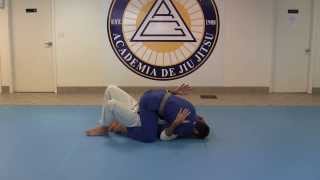

Arm and shoulder locks
Your elbow or shoulder is isolated and bent or straightened past its range.


Leg locks
Your foot, ankle, knee or calf is trapped in a leg entanglement. Learn these under supervision.
 Straight ankle lockCaught in Leg lock defenseEscape to Passing open guard
 Kneebar (Hiza Juji Gatame)Caught in Leg lock defenseEscape to Passing open guard
 Toe holdCaught in Leg lock defenseEscape to Passing open guard
 Inside heel hookCaught in Leg lock defenseEscape to Passing open guard
 Outside heel hookCaught in Leg lock defenseEscape to Passing open guard
 Calf slicerCaught in Leg lock defenseEscape to Half guard